

A Survival Guide For Your First Graduate role

So, the day has finally arrived that you have wished for over the last 3 years – no more exams, no more deadlines… FREEDOM! But now that day is here what do you do? As exciting as the working world can be, the transition from university to 8.30am starts can be tough. As a graduate myself, I had to deal with plenty of changes, which after 4 years I am finally adapting to. Based on my own experiences, I’ve compiled a survival guide for you eager grads to ensure you survive office life.

Appearance

I know after three years of uni you’re used to casual comfy outfits, but welcome to office life…wearing exactly what you want becomes a thing of the past. Employers are going to see you as ambassadors of their company and want you to appear smart and professional. So, the ripped jeans and converse will have to wait until dress down Friday.

Don’t be afraid to ask for help

No one is going to expect you to know everything straight away. Rather than sit at your desk wondering what you should be doing, ask one of your colleagues for help. We’ve all been there at some stage of our career, and after all your manager is there to show you the ropes.

Be realistic

Ok, so you’ve graduated with a solid degree and you’re ready to put your knowledge in to action. But remember, you are still at the beginning of your career! Your first job may not be as glamorous, exciting or fulfilling as you think it’s going to be. When you think of those city workers swanning about at lunchtime, taking clients to exciting meetings and wearing designer shoes, it’s easy to forget the hard work that involves reaching that point. But with determination and ambition there is no reason you can’t aim for that!

Be prepared to go the extra mile

This is your first job, and hopefully you’ve managed to secure it within a company that will invest in your development. Just remember that the more you put in, the more you’ll get out. If that means staying late a couple of nights, or doing a bit of research at home in the evenings, then do it! Just think how great it will feel when you secure that first promotion…

Office gossip

Everyone can be partial to a bit of gossip now and then, but remember you’re not with your uni mates anymore. Try and steer clear from any big office gossip, you’re better off keeping your head down and focusing on your work – your colleagues will respect you more for it.

Enjoy it!

You’ve spent at least 3 years studying for this, so try and enjoy it and give it your all! Yes, I’d be lying if I said we didn’t all have bad days – but as long as you have more good days at work than bad, then you’re more than likely in the right role.

Good luck, the working world is not as scary as it seems. If, however, you are yet to secure a grad role then take a look what a year in recruitment is like, if this sounds like the job for you then get in touch today, or email your CV to lauren.davison@highfield.searchstack.co.uk.

Graduates – The Reality of Your First Year in Recruitment

So, there we have it, my first year in recruitment is complete. What a rollercoaster it has been…but a rollercoaster I would get back on again and again and again.

Like a lot of graduates, I was unsure what career path I was going to go down. Straight out of uni I decided travelling and working seasons was for me, so off I went. I’d originally applied for an Easter placement at Highfield, however, with the decision to go off travelling, it wasn’t the right time…but I was told to stay in contact all the same. On my return, I got back in touch with Highfield because I liked how they had sold the business – the opportunity to progress quickly and the earning potential stuck in my mind and I knew that if I put the work and hours in I could quite quickly reap the rewards.

How did I find my first year?

Now my first year in recruitment is done and dusted, I can say that it has been a great career decision. In the last year, I have progressed from Trainee Consultant to a Recruitment Consultant, made friends, won incentives and my hard work has been constantly recognised. And yes, I still get that “warm, fuzzy feeling” of getting someone a job. One of my favourite memories is securing a candidate a role with a £5k pay rise plus generous bonuses, all because he didn’t realise what his skills were worth.

I’d be lying if I said it was all fun and games. I am a self-confessed ‘work-a-holic’ and it can sometimes feel that work is never finished, there is always something you could be doing. Recruitment is a constant learning curve, perseverance and self-motivation become your best friend – bounce back from the no’s because all you need is one yes. So, don’t be afraid to fail! It will make you better, embrace it, but never ever let it beat you!

Coming out of university with lots of academic experience and not so much working world experience was daunting. But, I have found recruitment to compliment my university degree perfectly by teaching me a host of new skills from general office work, sales language and objection handling and of course, how to multi-task. Don’t be fooled, recruitment is not just sales, its marketing, business, relationship management and problem solving to name a few.

My advice!

If you’re thinking about a career in recruitment, my advice to you is be creative and get stuck in. Think of being a recruitment consultant as running your own mini business, the more you put in the more you get out. With the right training, you have the power to be very successful.

So, for any graduates thinking about a career in recruitment, but not sure if it’s for them, why don’t you answer the following questions:

Are you ambitious and determined to succeed?

Do you want to be successful?

Are you looking for a career where the work you put in will always be rewarded?

Do you want to be part of a team that works hard but knows how to party?

If you’ve answered yes to those questions then I think you need to email your CV to lauren.davison@highfield.searchstack.co.uk, and apply for a Graduate Recruitment job with Highfield.

If I haven’t quite convinced you and you have any questions about my year in recruitment, then I am more than happy to help. Drop me an email, sam.eslinger@highfield.searchstack.co.uk

Quantity Surveyors – what is causing the skills shortage?

Over the past couple of years, we have seen a decline in the number of Quantity Surveyors across the Board within Civil Engineering and Construction. According to surveys, 65% of companies across Civil and Construction industries reported that there is a distinct lack of QS’s available for work.

Some argue that because of this shortage, Universities have been pushing through “not so great trainees”. The consensus being that Graduates lack the skillset to do the complicated job of a Quantity Surveyor at a level deemed acceptable by today’s fast paced market and its delivery targets.

But why is this? Surveys suggest that delivery pressure and lack of time for QS’ to mentor trainees play a big part. Old boys of the QS’ing world tell of stories of great mentors and being taken under wings, because they had the time to do so, whereas now, with a thinning market, trainees are being pushed and pulled through non-commercial routes such as Project Managers, thus losing valuable time to learn how to produce bills of Quantity or even run standard reports.

The shortage, we believe – has even impacted on the QS salary or pay rate. Whilst across the sectors QS pay rates can vary, certainly the lack of available QS’s has seen the reduction in QS’s wanting Permanent roles and a rise in Contractor numbers. Decent QS’s with significant experience know that they are well sought after in today’s market, enabling them to ask for more money in return.

I wonder if the real reason for the shortage is actually due to young people preferring to study within the ever-growing digital market. What are we doing to encourage youngsters to stay within Civil Engineering? We would love to hear your thoughts.

Highfield Professional Solutions set to climb Mount Snowdon

Here at Highfield, we love to raise money for many charities close to our hearts. No challenge is too big… so this year, on the 15th July, the bravest of Highfield are set to take on Mount Snowdon to fundraise for Crohn’s and Colitis Charity.

The Crohn’s and Colitis Charity are the UK’s leading charity in the battle against Crohn’s Disease and Ulcerative Colitis. This great cause works relentlessly to improve the life of the 300,000 people in the UK with Crohn’s, Ulcerative Colitis and other forms of IBD.

The Highfield team will be taking on Llanberis Path. With a length of 9 miles, and an ascent of 3300 feet, it is not for the faint hearted.

Not only is this an exciting challenge for the Highfield team, but it is an opportunity to raise money for an amazing cause.

Money raised will help support the charity to;

  • Provide essential services to people with Crohn’s, Colitis and other forms of IBD
  • Inform and influence decisions about the needs of people with conditions
  • Help develop local services
  • Raise vital funds to continue their work across the UK
  • Improve existing treatments and services, and discover new ones by taking part in research

If you would like to show your support to Highfield and the Crohn’s and Colitis charity, you can do so by donating to our Just Giving page.

Union talks set to put a stop to Hinkley strike threat

Fears of strike action hitting the £18bn Hinkley Point C construction programme have been discussed. However, after EDF stepped in, it seems the strike, which was triggered by the issue of bonus payments, could be off.

Strike fears emerged last week as the involved unions conducted a ballot of their members on whether to accept the proposed bonus offered by BYLOR. Members of both unions rejected the proposed bonus. They believed the proposal was inadequate to attract the quality of skilled workers required to complete the civil works phase of the project on time.

It seems the unions are now hopeful that, with the positive intervention of the client EDF, fresh talks will lead to an agreement and avert the need for industrial action.

Phil Whitehurst, GMB national officer for construction, said “Our members gave this derisory bonus offer the short shrift it deserved by overwhelmingly voting it down.

If the companies want to avoid strike action they need to make us a serious offer, which matches our members’ skills level, when we get back round the table.

If they don’t, they could be facing an industrial dispute and delays to the whole Hinkley Point project.”

It will be interesting to see once the talks take place. In the meantime, if you are looking for work within the nuclear industry check out our live Hinkley Point C vacancies or contact our expert nuclear consultant, Matt Casey, on 01489 774 010.

Highfield Professional Solutions shortlisted for Employer of the Year

Highfield Professional Solutions are thrilled to announce we have been shortlisted for Employer of the Year in the South Coast Business Awards 2017.

At Highfield Professional Solutions, we take great pride in our talent, and fully invest in the development and success of our staff. We understand and recognise that it is our employees that make our business unique and reputable, and the experience we provide is vital to our success. Ensuring staff feel appreciated, challenged and most importantly valued, is central to our core values and it is this focus that has led us to become an employer of choice in our region.

Sam Hughes, Director of Highfield Commented;

“Our entire team here at Highfield is paramount to our success.  We continually strive for excellence in the training and support of our staff, driving growth and creating jobs in an environment everyone can thrive and develop their careers.

It is a real honour to be nominated for this award and for our dedication to be recognised.”

The South Coast Business Awards, in partnership with Trethowans Solicitors, will take place on July 6th 2017 at the Hilton at the Ageas Bowl. It looks set to be a great event as the best of the South Coast business come together to celebrate.

We are delighted to have been shortlisted and are looking forward to the awards evening!

Should we be worried about Brexit? UK construction sector growth hits a four-month high

It seems like it is good news for the building sector, as it has seen its fastest pace growth in four months in April. This is showing real signs that the economy might be recovering a little momentum, after news of Brexit saw 2017 off to a slow start.

The Markit/CIPS UK Construction Purchasing Managers’ Index (PMI) rose to 53.1 from 52.2 in March, against forecasts in a Reuters poll of economists for a slight fall.

Builders have reported that they took on more staff last month, due to improvement in client demand. Put simply, more work means more employment in the sector.

It was Civil Engineering which grew at the fastest pace in just over a year, and a growth in house-building hit a four-month high.

However, it seems there is still some Brexit worry looming on the construction industry. Max Jones, Global Corporates Relationship Director for Construction at Lloyds Bank Commercial Banking explained;

“Some of the nervousness is coming from contractors with a focus on infrastructure, where the pipeline remains strong. The success of Crossrail has shown that mega-projects can be delivered on time and on budget but there are concerns about how government decision-making on infrastructure may be affected given the focus on Brexit negotiations.

“A further worry is skills and the fears over future access to EU workers, on which the UK construction industry is so reliant. Here, firms are continuing to use joint ventures to spread risk, share labour resources and ensure the best possible teams are available for the job.”

If the UK does not retain access to the European single market after Brexit the UK construction industry could lose more than 175,000 EU workers. An outcome like this could put key infrastructure and construction projects at risk or on hold. This would come at a worrying time when the construction sector is also facing other pressures, such as tax changes in the recent budget and an already there skills gap.

With the upcoming general election and the outcome of the Brexit negotiations still to come, it may be a while before we see the construction industry settle completely. However, with such growth, and the biggest rise in new orders since the beginning of the year, the sector seems to be in a strong pre-election position, bringing waves of positivity for the future of the UK construction industry.

Quantity Surveyors in UK – how could you earn more?

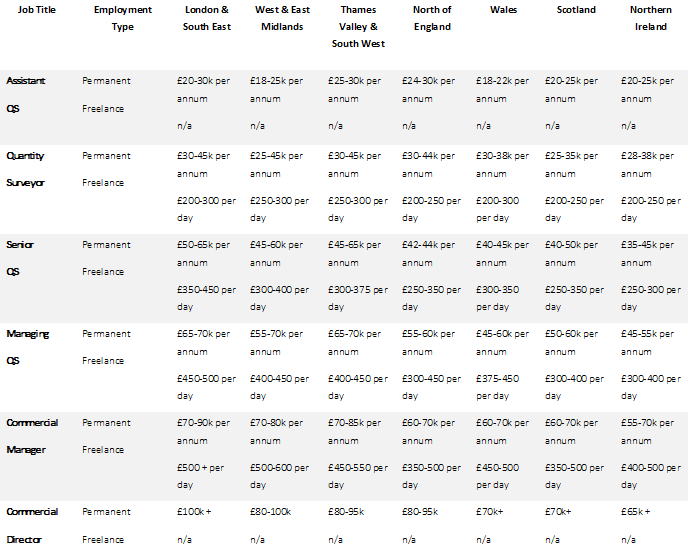
With the Quantity Surveyor market busier than ever it’s only natural that even the most content professionals are curious to know what the market is paying. So, if you are a Quantity Surveyor and wondering how you could increase your salary, you have come to the right place.

QS Salary


On average how much money can you expect to earn in London compared to other areas of the UK?

Candidates looking at working in London, or the surrounding counties, can typically expect up to a 20% – 30% rise in salary to compensate them for the increased cost of living in the capital. A quantity surveyor in Northern Ireland is set to earn the least with the salary being on average 27.5% less than the average national salary for QS jobs, however the cost of living is lower in Northern Ireland.

What experience range is most in demand?

Despite Brexit, the UK construction industry is set to grow from strength to strength. The skills shortage in relation to Quantity Surveying falls more within the junior to intermediate level.

If you are a Quantity Surveyor with anywhere between 2 through to 10 years good experience, you will be sought after. Surveyors within this bracket of experience will tend to be Assistant through to Senior level.

What sector provides the highest salary?

The nuclear sector remains the place to be if you are looking for the highest salaries.

Nuclear – £50,000

Construction – £45,000

Rail / Civil / Structural – £43,000

Water – £42,000

What can I do to increase my chance of getting a higher salary offer?

The more skills you have on your CV and can demonstrate, the more valuable of an asset you are to an employer due to your versatility within the business.

Here are a list of skills and points employers look out for on your CV;

  • Continued commitment to further education
  • Leadership skills
  • Project management skills
  • Strong contractual knowledge
  • Experience on major projects
  • Working on projects from start to completion

Will you get a higher salary working on the client side or the contracting side of the construction industry?

In general, salaries for a Quantity Surveyor are typically higher working for a main contractor than those working for a Consultancy or a Client.

That being said, the difference is minimal and can vary on what industry within Quantity Surveying you are working in.

Will I work more hours working within a consultancy or as a contractor?

If you worked out your salary on a ‘per hour’ basis, you would probably see that you earn more per hour working for a Consultancy. However, this again would be a minimal difference.

Typical hours worked:

  • Consultancy / Client: On average 37.5 – 40 hours per week, Monday – Friday
  • Contractor – On average 40 – 45 hours per week, Monday – Friday

If you are looking for your next role, or would like an informal chat with one of our expert consultants then get in touch today on 01489 774 010.

Tackling the Construction Skills Shortage

The ongoing skills shortage within the construction industry is driving up wages and has the potential to hold back vital infrastructure projects, including efforts to build more homes to end country’s housing crisis.

The Royal Institute of Chartered Surveyors (RICS) said construction wages rose by 6% in 2015, well ahead of the 2% UK average, because there are not enough workers.

While any shortage is affected by current market conditions, RICS has predicted that the skills shortage could impact 27,000 construction projects each year until 2019. According to the RICS UK Construction Market Survey, Bricklayers and Quantity Surveyors were the most sought over workers. It is reported that 66% of surveying firms have already been forced to turn down work due to a lack of staff.

A shortage of housing has driven up rent and house prices over recent years, most noticeably in London and the South East. Housebuilding is running at around half the level needed to meet demand, but housing starts fell in England.

“The construction skills crisis is slowing growth in a sector that is vital to UK plc,” said Sally Speed, skills and Talent Director at RICS. “Unless government looks to address the problem urgently, some of its key housing and infrastructure programmes could soon face crippling delays and spiraling costs. To tackle the problem, government must deliver a new skills strategy that will enable industry, unions, and educators to work together and deliver real solutions.

So what can be done to help with the current skills shortage?

To improve the skills shortage in the long term, the construction industry needs to change the younger generation’s perception of the engineering industry. That is why the STEM community are already working hard to introduce new initiatives aimed at improving children’s engagement with science and engineering.

The government has already invested over £1 billion in training and apprenticeship schemes. However, it is now down to the industry itself to play its part in attracting new workers and incentivising young people.

We would love to know what you think. Have you noticed a shortage of workers on site? What do you think the construction industry can do to help reduce the growing skills shortage?

Construction of new Football Stadiums creates demand for construction professionals

Over the next few years we will see a number of football stadiums getting a revamp and even completely new looks. These will become the stadiums of the future and as expectations of football stadiums increase, builds are becoming longer and more complex. As a result of the increase in workload the demand for skilled construction workers is rising.

Some stadiums are already making smooth progress and are buzzing building sites, others are in the pipe line and will be beginning over the next few seasons. Either way, they bring excitement of what the future may hold. Here we take a look at some of the stadiums on the list and how they are progressing.

Tottenham Hotspur – New Stadium

The yet unnamed stadium, is currently under construction right next door to Tottenham’s current home at White Hart Lane. The stadium is set to open in 2018 and will become the largest capacity football club ground in the capital city, seating 61,000 fans. The new stadium is expected to cost £750m, but will create around 3,500 jobs in the local area when it is finished, according to the club.

Wanda Metropolitano

Wanda Metropolitano is soon to become the new home to Atletico de Madrid. This football stadium is the largest stadium currently under construction within Europe, and is designed to meet the highest standards of comfort, security and visibility. The costs of the project are estimated to be 200million euros.

Stoke City

The club have commenced with the ‘filling in’ of the South East corner of the ber365 Stadium, with 1,800 covered seats. This work is scheduled to be complete before the start of the 2017/2018 season. This will result in the capacity of the stadium being increased to just over 30,000

Eurostadium

Although still in the planning phase and facing some controversy, the Dutch Eurostadium is set to dramatically increase demand when the build begins. The construction of the new national stadium has caused some stir with some concerns being raised. However, as the 2019 deadline is fast approaching for the UEFA deadlines for the Euro 2020 championship, it is likely that we will see a high demand for skilled construction professionals to ensure the work gets completed in time.

Brentford

The club have commenced with the building of the new stadium, with a 20,000 capacity. The construction of this football club will also see the construction of 910 flats and a hotel, which will no doubt call for an increase of workers within the area.

Scunthorpe United

Not as glamorous as the likes of Tottenham Hotspurs and Wanda Metropolitano, the new Scunthorpe United stadium is on track to be built in the near future. The League One side are expected to construct a 12,000 capacity stadium. An initial deal with the Lucent Group is said to have been reached to build it as part of one of their larger construction projects.

With new stadiums in the pipeline, it is not just an exciting time for the football industry but for construction professionals as well.

If you are currently looking for your next role, view our latest jobs here, alternatively give one of our expert consultants a call on 01489 774 010.


Highfield are a Certified Carbon Neutral Business

Submit a Vacancy

Need to hire BIM talent? Complete this form and a member of the team will be in touch.

"*" indicates required fields